_edited_edited.png)
Perception Drift in Aesthetics Why Results Feel Gone After 3 Weeks
A patient loves the mirror at two weeks. By week three or four, they may feel strangely disappointed. The lips look “normal.” The softened lines seem to have returned. The lifted brow no longer feels lifted. They come back worried that their dermal filler dissolved, their neuromodulator wore off, or the treatment simply did not last.
Often, the result has not vanished. The eyes and brain have adjusted.
This is the core of perception drift in aesthetics. It describes the way a person’s visual and emotional response to a cosmetic result changes after the initial contrast fades. The face may still look improved in photos, yet the person no longer experiences it as new or dramatic.
The idea matters because aesthetic medicine lives in a narrow zone between biology, psychology, and expectation. Fillers, neuromodulators, lasers, and skin treatments create visible changes, but those changes are interpreted by a brain that constantly adapts to what it sees.

This article is for education only and is not medical advice. Treatment timing, dosing, and follow-up should always be guided by a qualified medical professional.
Perception drift explains why stable results can feel like they disappeared
Perception drift is not the same as poor treatment, rapid metabolism, or unrealistic vanity. It is a normal feature of human perception.
Human vision is adaptive, not absolute. The brain does not record the face like a camera and compare every detail against a fixed file. It updates what “normal” looks like through repeated exposure.
That means the first few days or weeks after treatment carry the strongest contrast. A softened fold, smoother forehead, restored cheek contour, or more hydrated lip stands out because it differs from the familiar pre-treatment face. The change is easy to notice because the old visual baseline is still active.
By about week three, many patients have looked at the updated face dozens or hundreds of times. The new version becomes familiar. The emotional charge drops. What once felt fresh now feels neutral.
This is where confusion starts. The patient may assume:
“My filler is gone.”
“My Botox already wore off.”
“I need more.”
“The result was never enough.”
In some cases, the concern is valid. Swelling may have settled. Neuromodulators may still be reaching full effect or may have been underdosed. Filler may integrate into tissue, making the result look softer and more natural than it did at first. But in many cases, standardized photos still show a clear difference.
The treatment changed the face. Then the brain changed the reference point.
The research basis connects aesthetic perception with visual adaptation
The concept has been discussed in aesthetic medicine literature. Dr. Charles A. Sola and Dr. Sabrina G. Fabi addressed related concerns in a paper published in Dermatologic Surgery in December 2019, drawing attention to how patient perception can shift after cosmetic treatment.
A later study, titled “Aesthetic delusions: an investigation into the role of rapid visual adaptation in aesthetic practice,” was published in Clinical, Cosmetic and Investigational Dermatology in 2021. That study explored how rapid visual adaptation may influence aesthetic judgment.
The term “aesthetic delusions” can sound harsh, but the underlying issue is familiar and clinically useful. People adapt quickly to visual change. When the brain recalibrates, the treated appearance may start to feel like the original face, even when objective signs of treatment remain.
This does not mean a patient is imagining everything. It means the patient’s current perception may not match the measurable change.
A simple analogy helps. Walk into a room with a strong scent, and it is obvious at first. Stay there long enough, and the smell seems to fade. The scent may still be present, but the nervous system has adjusted.
The face works in a similar way. A visible improvement can become less noticeable once the brain stops treating it as new information.
The 3-week mechanism has three main drivers
The “3-week” window is not a strict biological deadline. It is a common point when the early excitement has settled, swelling has often reduced, and the patient has had enough repeated exposure to adapt to the new look.
Three factors tend to drive the experience.
Baseline reset makes the new face feel like the default
The first factor is baseline reset.
Human visual perception depends heavily on comparison. After treatment, the brain compares the updated appearance with the known pre-treatment face. That comparison creates the early satisfaction moment.
For example, a patient who receives lip filler may notice better hydration, shape, or balance in the first week. Each mirror check reinforces the contrast between “before” and “after.”
By week three, that contrast can fade. The brain starts treating the updated lips as the default. They are no longer “enhanced lips.” They are just “my lips.”
The same can happen with:
Forehead lines softened by neuromodulators
Cheeks restored with filler
Tear troughs improved by careful correction
Jawline contour that looks cleaner in profile
Skin texture after resurfacing or collagen-stimulating treatments
This is why natural-looking work can be both successful and vulnerable to perception drift. When a result blends well with the face, it may stop calling attention to itself.
Memory fade weakens the mental image of the pre-treatment face
The second factor is memory fade.
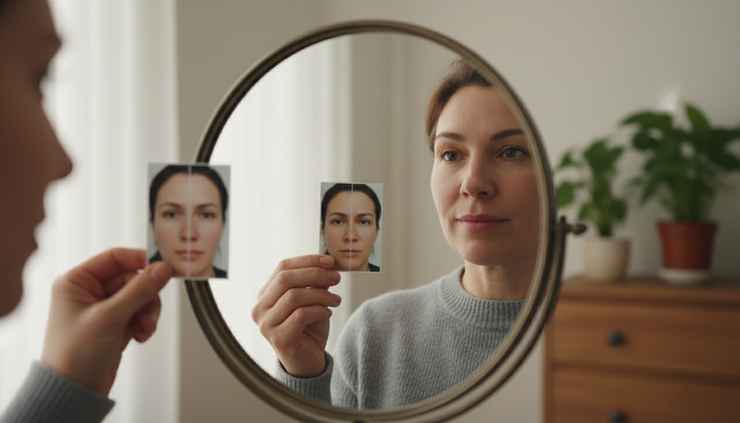
People often overestimate how clearly they remember their former appearance. In reality, facial memory is flexible. The mind keeps a general impression, not a precise clinical record.
The pre-treatment face starts to fade once the patient stops seeing it every day. Details that once bothered them may become hard to recall accurately. The depth of a fold, heaviness of a brow, degree of asymmetry, or shadow under the eye becomes less vivid.
This is why patients sometimes look surprised when they see their original photos.
They may say:
“I forgot my lines were that deep.”
“I didn’t realize my lower face looked heavier before.”
“I thought my lips looked the same, but they don’t.”
“I can see it now that the photos are side by side.”
Photos do not replace lived experience, but they protect against memory distortion. They give both patient and provider a shared visual reference that does not drift with emotion, lighting, or familiarity.
False regression turns emotional neutrality into perceived loss
The third factor is false regression.
This happens when the treatment result remains present, but the patient feels as if it has regressed because the emotional response has faded.
At first, the change may feel exciting. The face looks rested, smoother, or more balanced. That feeling becomes part of the perceived result.
By week three or four, the emotional lift may soften. The improvement now feels normal. When that happens, the brain may interpret “I no longer feel surprised” as “the result is gone.”
This can lead patients to request more product too soon. In filler treatments, that pattern can slowly push results beyond the original goal. In neuromodulator treatments, it can create frustration if patients expect the same emotional high at every visit.
False regression is one reason follow-up visits should be structured. The question should not only be, “How do you feel?” It should also be, “What do standardized photos show, and how does the result compare with the treatment plan?”
Normal settling can look like loss, even when the result is working
Perception drift is not the only reason results feel different after three weeks. Real physical changes occur during early healing and settling.
For fillers, early swelling may create a fuller look that is not the final result. As swelling fades and the product integrates, the area can look more natural. That does not mean the filler disappeared. It means the early post-treatment phase ended.
For neuromodulators, the timeline is different. Many patients begin to see changes within several days, with fuller effect often assessed around two weeks, depending on the product, muscle activity, dose, and individual response. By week three, the face may look smoother but less “new” to the patient.
For energy-based or collagen-stimulating treatments, visible change may develop more gradually. Patients may not see a dramatic early shift, then still adapt to subtle improvements as they appear.
A good follow-up separates these layers:
What may be happening | What it feels like | What helps clarify it |
Swelling has settled | “The filler went away” | Comparing day-of, early, and settled photos |
The brain reset the baseline | “This is just my face again” | Reviewing pre-treatment images |
Memory of the old face faded | “I don’t think I looked that different” | Using consistent lighting and angles |
More treatment may be needed | “The change is too subtle” | Assessing anatomy, goals, and safety limits |
The key is not to dismiss patient concerns. The key is to evaluate them with better tools than memory alone.

Good documentation protects both the patient and the result
The most practical answer to perception drift is not persuasion. It is documentation.
High-quality clinical photography can make the difference between a productive follow-up and an emotionally driven retreatment. The photos should be as consistent as possible.
Useful photo habits include:
Same camera distance
Same facial angles
Same lighting
Same expression
Hair pulled away from the treatment area when relevant
No filters or beauty settings
Resting and animated views when neuromodulators are involved
A casual selfie can be misleading. Bathroom lighting, front-facing camera distortion, head tilt, and expression changes can all exaggerate or hide results. A patient may compare a flattering post-treatment selfie with a harsh mirror view three weeks later and feel the result failed.
Providers can also help by naming perception drift before it happens. A short explanation at the first visit can reduce anxiety later.
For example:
“Around three or four weeks, many people feel like their result has faded. Sometimes that is normal settling, but often the brain has simply accepted the new look as normal. That is why we use photos before deciding whether more treatment makes sense.”
This sets a healthier frame. It gives the patient language for the experience. It also creates a pause before adding more product.
Perception drift is one reason aesthetic treatment should have a plan
Aesthetic medicine can lose its way when every visit starts from the current feeling in the mirror. Feelings matter, but they are not stable measurement tools.
A treatment plan gives the process structure. It defines what is being improved, what should remain natural, and when reassessment should happen.
A clear plan usually includes:
The patient’s main concern
The anatomical reason for that concern
The proposed treatment
Expected onset and settling time
When photos will be reviewed
Signs that retreatment may or may not be appropriate
Safety limits for product amount or treatment frequency
This matters most for patients who enjoy a result at first, then quickly want more. If every baseline reset leads to retreatment, the endpoint keeps moving. The face may slowly shift away from the balanced result the patient originally wanted.
The goal is not to block reasonable refinement. It is to avoid treating adaptation as failure.
Patients should not be made to feel wrong for drifting
The language around aesthetic perception needs care. Patients should not be mocked or shamed for forgetting what they looked like before treatment. This is part of how the brain works.
A person can be thoughtful, realistic, and still experience perception drift. The mirror is emotional. The face is personal. Cosmetic treatment often touches confidence, identity, aging, and self-recognition.
That makes validation important.
A helpful response sounds like:
“I understand why it feels that way.”
“Let’s compare today’s photos with where we started.”
“Some settling is expected, and some of this may be visual adaptation.”
“We can decide based on the photos, your goals, and what is safe.”
A less helpful response sounds like:
“You’re just used to it.”
“It’s all in your head.”
“You need more.”
“You’re being too critical.”
Perception drift sits between psychology and anatomy. The best clinical conversations respect both.

The real takeaway is to compare before you correct
The three-week moment is a useful checkpoint because it reveals the difference between visible change and perceived change. Baseline reset, memory fade, and false regression can make a good result feel ordinary far sooner than expected.
That does not mean every concern is perception drift. Sometimes dosing needs adjustment. Sometimes filler has settled more than planned. Sometimes the treatment choice did not match the anatomy. A careful evaluation can sort that out.
The safest habit is simple: compare before you correct.
Look at standardized images. Review the original goal. Allow normal settling. Ask whether the concern is a true loss of result or a loss of contrast. When patients and providers understand that distinction, follow-up visits become calmer, safer, and more honest.
A result has not failed just because it feels normal. In many cases, feeling normal is exactly what a natural aesthetic result was meant to do.


Comments